
Makes and years
Toyota and Lexus were early, with the Prius and the RX offering one from 2004 and upper trims of the Camry from 2007. Infiniti had it on the FX in 2003, then the QX60 from 2013 and the Q50 from 2014. Nissan made it standard on the 2007 Altima. Honda and Subaru followed in 2013 with the Accord and Outback.
Mazda offered it on a few models from about 2009, then more widely from the 2013 CX-5 and 2014 Mazda3. Ford's version began on the 2010 Taurus, Hyundai's on the 2011 Sonata and Kia's on the 2011 Optima EX. Chevrolet and GMC came later, on upper trims of the Tahoe and Yukon from 2015 and the Malibu from 2016. Trim counts as much as year: a 2014 Optima LX starts with a flip key, the EX with a button, so the VIN settles it.
How it is programmed
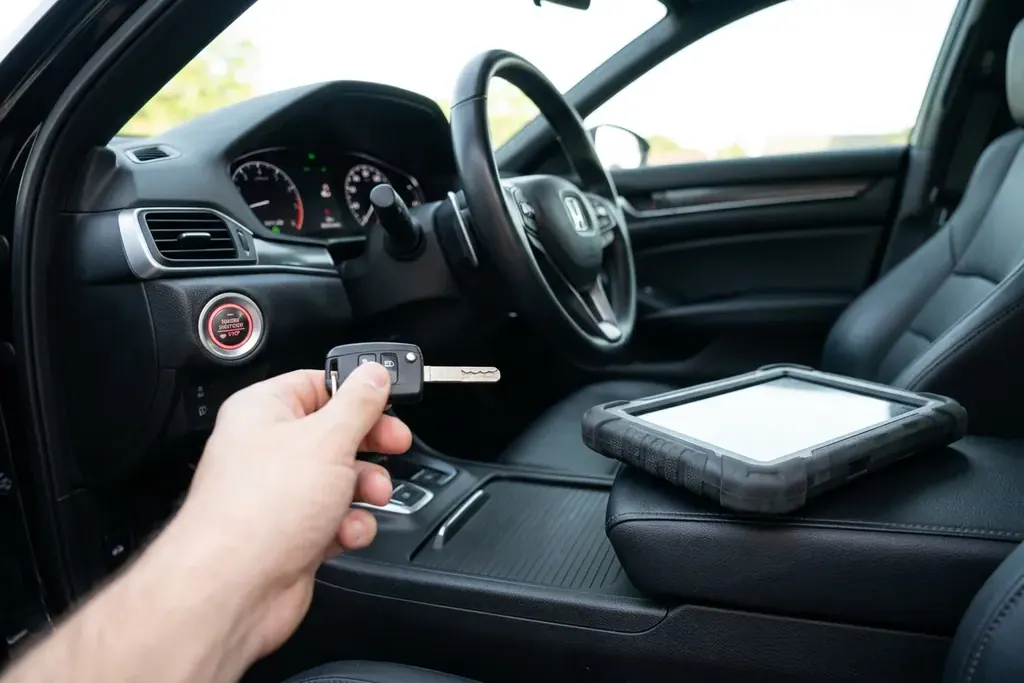
The blade comes first, cut by code in the van. Then the programmer connects at the diagnostic port and opens the car's key memory, which depending on the make takes a security PIN, an online login, or a timed wait the maker built in, as Toyota and Lexus do. The new fob is enrolled for starting and for entry, and both get tested before you pay.
On some makes, adding a fob clears the stored list and relearns every key, so bring every fob you own or the absent ones stop working. A dealer runs the same enrollment on its factory tool, but in the service bay, once the parts department has sold you the fob, with the labor on a separate line of $100 to $180.
What it costs
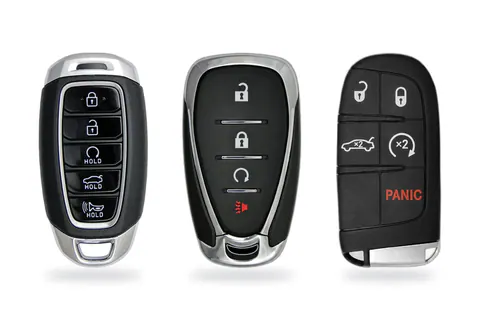
A new smart key runs $229 to $399 at your car, covering the fob, the blade, programming and the drive, where typical dealer quotes are $400 to $750 before any tow.
The make sets the floor: Chevrolet and GMC $229, Honda and Ford $239, Toyota and Nissan $249, Lexus $289. With no fob left, add $60. Volkswagen, Audi and BMW fobs sit on the European row of our price table.